The Cash Flow Log Book: A Practical Instrument for Financial Visibility and Operational Discipline
Financial management often gets distilled into complex software dashboards, automated alerts, and predictive algorithms. Yet, for countless professionals, small business owners, freelancers, and households, the most profound insights emerge from a deliberate, manual engagement with numbers. A Cash Flow Log Book serves as that tactile anchor—a physical space where income and expenses cease to be abstract digits on a screen and become tangible patterns that tell a story. When that log book is carefully designed as a Cash Flow Log Book KDP Interior, it transforms from a simple notebook into a structured, professional-grade tool calibrated for clarity and long-term usability.
The modern economy rewards those who understand liquidity not as a monthly snapshot but as a continuous, dynamic stream. Recording every inflow and outflow by hand does something that spreadsheets often fail to do: it forces mindful recognition of each transaction. This cognitive reinforcement builds a kind of financial proprioception—an intuitive sense of where money is moving, when, and why. A well-crafted log book interior, formatted precisely for platforms like Amazon KDP, makes this practice accessible and sustainable because the layout itself guides consistency without overwhelming the user.
Why a Physical Log Book Outperforms Purely Digital Tracking
Digital tools excel at aggregation and calculation, but they suffer from notification fatigue and the ease of auto-categorization errors. When a transaction imports automatically, the brain barely registers it. By contrast, the act of opening a physical book to a fresh page, dating an entry, writing a description, and filling in numerical columns creates a multisensory ledger experience. This process engages motor skills, visual focus, and cognitive recall simultaneously, which studies on handwriting and memory suggest strengthens retention and analytical processing.
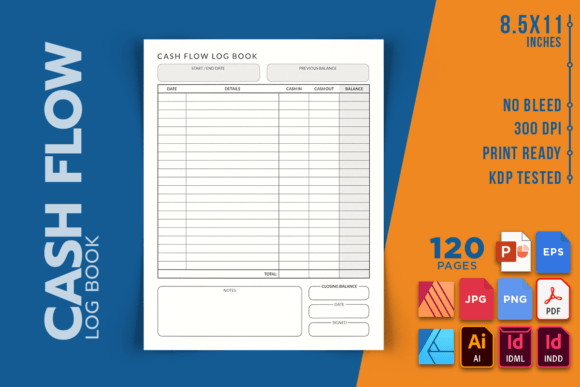
A Cash Flow Log Book also provides a sanctuary from distraction. There are no pop-ups, no temptations to check email, no battery anxiety. The book sits on a desk, ready to serve a single purpose. For creative professionals, tradespeople, and entrepreneurs who already spend excessive screen hours, this analog interlude becomes a grounding ritual. The design specifications of the interior—dimensions of 8.5 x 11 inches, 120 pages of generous writing space, and a no-bleed format—reinforce that feeling of openness and professional heft. Each page offers ample real estate to log entries without cramping, allowing for detailed notes, client references, or project codes that might otherwise be excluded in a cramped digital memo field.
The technical production values embedded in the Cash Flow Log Book KDP Interior matter more than casual observers realize. A resolution of 300 DPI ensures that every line, every column header, every subtle grid mark prints with razor-sharp precision. When a user photocopies a page for archival purposes or scans it into a digital record, that high resolution prevents the feathering and blur that plague lower-quality interiors. The editable source files—available across an extensive range of formats including INDD, IDML, AI, PDF, PNG, JPEG, EPS, AFDESIGN, AFPUB, and PPTX—mean that the interior can be tweaked for specific needs while retaining professional-grade bones.
The Anatomy of a Purpose-Built Financial Tracking System
Not all log books are created equal. A generic notebook leaves the user to invent structure from scratch, which often leads to inconsistency and eventual abandonment. A properly designed cash flow log interior pre-configures that structure without being rigid. Common elements include dedicated fields for date, description, category, income amount, expense amount, and running balance. Some layouts incorporate reference codes for tax categories, payment methods, or client identifiers. These fields act as gentle prompts, reducing the mental load of deciding how to organize each entry.
The no-bleed characteristic is particularly crucial for a financial log book. Unlike artistic journals or photo books where ink bleeding through the paper can be an acceptable aesthetic, financial records demand legibility on both sides of every sheet. The ability to print the interior pages at home, in an office, or at a print shop without worrying about ghosting or bleed-through preserves the integrity of the data. This practical consideration elevates the KDP interior from a digital file to a trustworthy physical asset.
Consider the following structural advantages that a well-designed interior provides over improvised alternatives:
- Consistent column width and alignment that prevents numbers from drifting across the page, making at-a-glance weekly and monthly reviews significantly faster.
- Predetermined row spacing that accommodates normal handwriting size without forcing users to squish entries or waste half a page per transaction.
- Logical grouping of related fields that mirrors the natural flow of reviewing a receipt, recalling a payment, and updating a running total.
- Clean typography and subtle visual hierarchy that reduces eye strain during extended reconciliation sessions.
Use Cases Across Diverse Professional and Personal Contexts
The versatility of a Cash Flow Log Book means it adapts to remarkably different user profiles with equal utility. A freelance photographer tracking unpredictable project income and equipment rental expenses needs exactly the same core functionality as a small restaurant owner monitoring daily till counts and supplier payments. The common thread is the need for chronological clarity, customizable categorization, and a durable record that can be referenced during tax season or financial reviews.
For small business owners, the log book becomes a daily operational dashboard. The 120-page count provides enough capacity to log an entire quarter of daily transactions with room for summary notes, making it a natural fit for quarterly estimated tax preparations. The large 8.5 x 11 inch format means invoices, receipts, or checks can be temporarily paperclipped to a relevant page without obscuring the writing area.
Freelancers and gig workers who often juggle multiple income streams benefit from the discipline of manual logging because it forces them to confront the true volatility of their cash flow. Seeing three thin weeks juxtaposed against a windfall month creates a visual narrative that averages and projections often obscure. This honest confrontation builds better savings habits and more realistic rate-setting over time.
Households using the log book for joint financial management find that a shared physical record reduces miscommunication. Partners can review the book together during weekly budget meetings, circling anomalies, and discussing upcoming large expenses. The act of co-maintaining the log fosters financial transparency and shared responsibility in a way that separate app logins cannot replicate.
Educators and students in personal finance courses benefit from a structured Cash Flow Log Book KDP Interior as a teaching tool. The editable source files mean instructors can customize column headers to match curriculum objectives—perhaps adding fields for savings transfers, charitable giving percentages, or investment contributions—before printing copies for an entire class. The availability of formats like PPTX even allows for digital projection of example pages during lectures.
Production and Customization: The Value of Editable Source Files
One of the most overlooked aspects of a KDP interior product is the post-purchase flexibility embedded in the file types provided. A static PDF is useful for straightforward printing, but access to INDD (Adobe InDesign), AFDESIGN (Affinity Designer), and AFPUB (Affinity Publisher) files opens the door to meaningful customization. A real estate investor might want to add columns for property address and tenant name. A nonprofit organization might need a dedicated grant-tracking field. The ability to modify the source file without rebuilding the entire grid system from scratch saves hours of design time.
The inclusion of AI (Adobe Illustrator), EPS, and SVG vector formats ensures that any graphical elements within the interior—logos, decorative borders, subtle watermarks—scale perfectly across print runs of different sizes or when adapted for other products. This vector fidelity matters when the interior might be used as part of a branded suite of business tools.
Print flexibility is another practical consideration. Someone who prefers spiral binding can print the PDF or PNG pages at a local shop and have them bound with a clear cover. A home office user with a high-quality laser printer can keep a digital copy on file and print a fresh 30-day supply at a time, using the JPEG files for quick page selection. The high-resolution 300 DPI output guarantees professional results regardless of the printing method chosen.
Information Architecture for Long-Term Financial Insight
The value of a Cash Flow Log Book compounds over time not just from the entries themselves, but from the patterns that emerge during periodic review. A well-designed interior includes subtle elements that facilitate this meta-analysis. Some versions incorporate monthly summary blocks or quarterly overview sections. Others leave generous margin space for highlighting seasonal trends, marking unusual transactions with sticky tabs, or noting changes in recurring expenses.
When the interior is formatted specifically as a Cash Flow Log Book KDP Interior meant for self-publishing and print-on-demand, the file is tested and proven to meet Amazon KDP's technical requirements. This means no frustrating upload rejections due to margin errors, font embedding issues, or color space mismatches. The file has already passed the rigorous automated checks that KDP performs, which translates to a smoother experience whether the buyer intends to publish their own version or simply wants a reliable, print-ready document for personal use.
The 120-page structure hits a psychological sweet spot. It is substantial enough to represent a serious commitment to financial tracking, yet not so thick that it becomes intimidating or unwieldy. For someone tracking daily cash flow, 120 pages might cover roughly four months, aligning naturally with quarterly financial reviews. For weekly trackers, it spans well over two years, making it a lasting companion rather than a disposable consumable.
E-E-A-T: Why This Tool Aligns with Expertise, Authoritativeness, and Trustworthiness
Google's guidelines increasingly reward content and products that demonstrate real-world experience and technical competence. A Cash Flow Log Book embodies those principles because it is, by design, a tool that requires and develops financial literacy. It does not make grandiose promises of passive income or automated wealth. Instead, it provides a framework for the consistent, sometimes tedious, but profoundly grounding work of financial awareness.
The interior files, editable and high-resolution, reflect a commitment to quality that knowledgeable users recognize immediately. Amateur layouts use default fonts with awkward spacing; professional interiors use kerning-adjusted typography, optically balanced margins, and grid lines that align perfectly at intersections. These details communicate trustworthiness before a single number is written. When someone holds a page printed at 300 DPI with no bleed, the tactile experience reinforces confidence in the tool itself.
From a practical standpoint, the Cash Flow Log Book supports the kind of financial recordkeeping that auditors, tax professionals, and business advisors respect. Digital records can be altered silently, but a sequentially filled physical log with consistent handwriting and chronological coherence provides a layer of evidentiary integrity. This does not replace digital backups—it complements them. The smart practice involves periodically scanning or photographing completed pages and storing them in encrypted cloud folders, creating a dual-layer archival system.
Integrating the Log Book into a Broader Financial Workflow
The greatest mistake users make is treating the log book as an isolated artifact. Its power multiplies when connected to other financial practices. For example, a weekly review ritual might involve opening the log book alongside bank and credit card statements, reconciling every line item. Discrepancies become immediately visible. Forgotten subscriptions surface. The manual cross-referencing process, though time-consuming, builds a level of financial intimacy that automated alerts cannot replicate.
For those who run small product-based businesses, the log book can capture granular details that accounting software classifies too broadly. A maker selling at weekend markets can log not just total sales but weather conditions, foot traffic estimates, and specific inventory that moved well. These contextual notes, scribbled in the margins of a Cash Flow Log Book, become invaluable business intelligence during off-season planning.
Real estate investors and property managers often maintain separate logs per property. The Cash Flow Log Book KDP Interior, with its editable source files, allows for the addition of property-specific fields—perhaps columns for maintenance category codes, tenant communication dates, or security deposit allocations. Printing a customized version for each property creates a standardized yet adaptable system that scales across portfolios of any size.
The Emerging Relevance in an Age of Financial Complexity
As gig work expands, side hustles proliferate, and traditional employment gives way to diversified income portfolios, the need for individualized financial tools grows. Off-the-shelf accounting software assumes a certain business structure that many modern earners do not fit. The freedom to define categories, set personal review rhythms, and capture hybrid personal-business transactions in a single coherent log makes the physical book an enduring solution.
The environmental and psychological dimensions also warrant mention. A log book consumes no electricity, requires no updates, and generates no distracting notifications. It occupies a small physical footprint while providing a permanent, unalterable record. In a world of disposable apps and subscription fatigue, the one-time investment in a well-designed interior that can be printed endlessly represents a quietly radical act of technological simplicity.
The fact that the interior is provided as an INTERIOR ONLY product, requiring the user to design their own covers, is actually a feature for many. It invites personalization. A craftsperson can design a leather cover. A digital artist can create a custom wrap. A business can brand the log book for client gifts. This separation of interior structure from exterior design respects the different skills and preferences of the end user while delivering exactly what matters most: a flawless, print-ready financial recording system.
Sustainability of Manual Recordkeeping
Trends come and go, but the fundamental practice of recording money in and money out predates all technology and will outlast any platform. The Cash Flow Log Book represents continuity with centuries of accounting wisdom while embracing modern production standards. The 120 pages, 8.5 x 11 trim size, and no-bleed format are not arbitrary specifications—they are the result of iterative design that balances portability, writing comfort, and archival durability.
For professionals who advise others on financial matters—accountants, coaches, counselors—recommending a reliable log book interior provides a concrete first step that feels manageable. It does not require learning software, remembering passwords, or granting third-party access to financial accounts. It requires only the willingness to show up daily and pay attention. In that sense, a well-crafted Cash Flow Log Book KDP Interior is not merely a product; it is an invitation to a more conscious relationship with money, backed by the reliable performance of high-resolution files that print beautifully every time.