Nonogram Puzzle Interiors-200 Puzzles: A Practical Anchor for Daily Mental Clarity
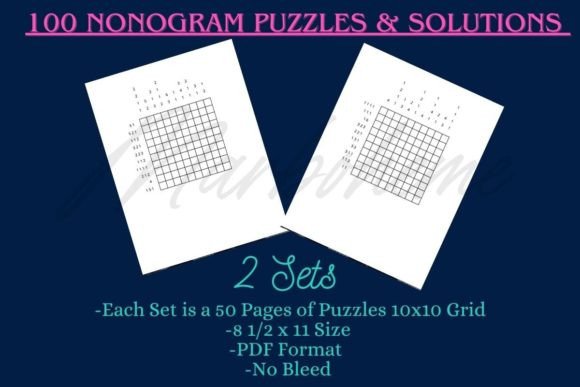
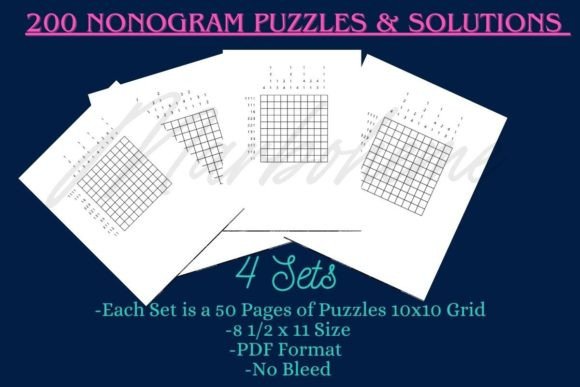
Nonograms, often called Picross or Griddlers, are more than simple grid-based games. They operate on a system of numbered clues that demand logical deduction to reveal a hidden image. Nonogram Puzzle Interiors-200 Puzzles brings this experience into a streamlined, accessible format designed for people who value both mental exercise and practical ease. This collection provides 200 carefully structured 10×10 puzzles, split into two packets of 50 each, with solutions immediately accessible on the following page. The PDF is formatted for standard 8.5×11-inch paper, making it equally usable on a tablet, a computer screen, or printed out at your desk.
What makes a puzzle book relevant to a professional, creator, or entrepreneur is not the puzzles alone but how they slot into a real schedule. Cognitive breaks are not frivolous; when chosen well, they reset working memory, dissolve the residue from a previous task, and prepare the brain for the next challenge. A nonogram accomplishes this with a defined beginning, middle, and end. You read the clues, translate them into filled and empty squares, and eventually see a small picture emerge. That moment of closure provides a clean cognitive transition, which is hard to achieve with open-ended scrolling or passive content consumption.
Because the puzzles are 10×10, they sit in a sweet spot: complex enough to engage, short enough to complete in five to ten minutes. This makes the collection an effective tool for time-boxed mental resets rather than a procrastination sinkhole. The Nonogram Puzzle Interiors-200 Puzzles format respects the need for boundaries. You are not diving into an infinite feed of puzzles; you have 200 distinct challenges, each with a verified solution, so the activity remains contained and satisfying.
Where Logic Puzzles Fit into a Broader Process
Every workflow, whether creative, analytical, or operational, cycles through phases of intense focus, shallow coordination, and recovery. Most people ignore the recovery piece or treat it as accidental downtime. A structured puzzle fills that gap intentionally. Instead of checking messages or news headlines between deep work blocks, spending precisely one puzzle’s worth of time on a nonogram gives the prefrontal cortex a rest while keeping the perceptual and logical systems lightly active. This prevents the cognitive inertia that sets in after a purely passive break.
For individuals managing multiple projects—marketers alternating between campaign analysis and content creation, developers switching from debugging to feature design—the shift cost is real. A 10×10 nonogram acts as a bridge. The rule set is simple and consistent, so the brain does not need to learn anything new each time. You open the PDF, pick up where you left off, and work through a grid. When you flip to the solution page and see the image, you experience a small reward that clears the mental palette before moving to the next demand.
This collection’s organization supports that process. The puzzles are divided into two packets. You might complete a packet over a month, using it as a daily warm-up or a post-lunch reset. Because the solutions are on the very next page, you never lose momentum hunting for an answer key at the back of a book or in a separate file. That tiny friction reduction matters when the goal is a seamless transition.
Before a Task: Priming the Logical Engine
Starting a demanding task cold often leads to early indecision. A short nonogram session calibrates the brain for pattern recognition and rule-based thinking. The numbers along the rows and columns require you to hold multiple constraints in mind, much like budgeting, scheduling, or structuring an argument. After solving even one puzzle, entering a spreadsheet or outline feels less jarring because you have already activated the same cognitive circuits.
Keep the PDF open on a secondary device or a printed stack near your workspace. Before a writing session, solve one puzzle. Before reviewing a contract or editing a design draft, work through a single grid. The temporal cost is low, but the alignment with the upcoming task type—logical, sequential, detail-oriented—makes the transition smoother.
During a Project: Pacing and Energy Management
Long projects fatigue the brain’s inhibitory control. Decision quality drops, and the temptation to rush increases. Scheduled nonogram breaks serve as mini-chapters. You can set a rule: after every 90 minutes of focused work, complete two puzzles before checking email or standing up. The Nonogram Puzzle Interiors-200 Puzzles PDF makes this easy because you can print a block of puzzles for the week and check them off as you go, or mark up the digital file with a stylus. The physical act of marking squares, whether on paper or screen, provides a tactile contrast to keyboard and mouse work.
During collaborative projects, these puzzles can also function as a low-stakes team energizer. Print a few copies of the same puzzle and see who completes it fastest during a five‑minute stand‑up break. It shares the logic of pair programming or group problem‑solving without the pressure of a client deliverable. Because the solutions are immediately available, no facilitator needs to spend time verifying answers.
After a Task: Defusing and Recognizing Completion
One under-discussed aspect of productivity is the ability to disengage from a completed task. People often carry cognitive leftovers into the next activity because they never signaled an ending. Finishing a nonogram provides that signal. The revealed image—a tiny interior scene, an object, a symbol—marks the end of a micro-goal. This closure ritual helps you consciously close the previous project file, both literally and mentally. After solving, you review the solution, confirm accuracy, and then turn to the next responsibility without the lingering hum of unfinished business.
Practical Compatibility and Setup
The Nonogram Puzzle Interiors-200 Puzzles PDF is formatted for 8.5×11-inch paper, a deliberate choice that simplifies integration into most home and office setups. If you print double‑sided, the puzzle appears on one side and the solution on the reverse, eliminating the need to flip between sections. For tablet users, applications like GoodNotes, Notability, or even a basic PDF viewer allow you to mark the grid directly with a finger or pencil. The file remains clean and reusable; you can print a packet multiple times for repeat practice or for different family members.
Organization is straightforward. The two packets provide a natural breakpoint. You might complete Packet 1 over a quarter, using it for morning priming, and save Packet 2 for a travel week or a period of high stress when deliberate resets become more critical. Alternatively, bind the printed sheets into a personal puzzle journal, adding notes about your solving time or strategies. This transforms the collection into a record of your cognitive rhythms.
Because the puzzles are 10×10, they never demand extensive erasing or backtracking. A small straightedge, a fine‑tip pen for marking filled squares, and a pencil for tentative marks are all you need. If you prefer a fully digital workflow, keep the PDF in a dedicated folder alongside other productivity tools like time‑block templates or focus‑timer apps. Launch it as part of a shortcut that also starts a 10‑minute timer, reinforcing the break’s boundaries.
Building a Reliable Routine with 200 Puzzles
Consistency amplifies the benefits of any cognitive practice. With 200 puzzles available, you have enough content to sustain a daily habit for months without repetition. Structure your usage around a predictable trigger. For example:
- Morning anchor: Solve one puzzle immediately after your first cup of coffee, before opening email. This replaces the habit of starting the day reactively.
- Midday transition: Complete two puzzles after lunch to overcome the post‑meal energy dip and re‑engage with analytical work.
- End‑of‑day wind‑down: Solve a puzzle as the final focused activity before shutting down your computer. It separates work time from personal time.
Track your progression through the packets. A simple check‑off sheet noting the puzzle number and date keeps you oriented. Since the puzzles are not ordered by difficulty—they maintain a consistent 10×10 challenge level—you can jump around or work sequentially. The consistency of the grid size means you refine your solving technique over time. You will start recognizing patterns: a “1” alone in a 10‑square row always means a single filled square surrounded by blanks; a “10” means the entire row is filled. These micro‑insights accumulate, making later puzzles faster and the process more satisfying.
The solutions on the next page function as a quality control mechanism. If you make an error, you can catch it immediately rather than compounding mistakes across the grid. This immediate feedback loop is invaluable for learning. Over the course of 200 puzzles, you will naturally develop stronger deduction skills, which carry over into other areas where systematic elimination of possibilities is required—debugging, proofreading, or auditing a process.
Long‑Term Use and the Value of Deliberate Mental Resets
The long‑term value of Nonogram Puzzle Interiors-200 Puzzles lies not in any single solution but in the sustained practice of focused, offline problem‑solving. In an environment saturated with notifications and context switches, the ability to sit with a single, self‑contained challenge is something that must be maintained. Puzzles that require logic, patience, and a bit of visual imagination strengthen the exact capacities that fragmented digital work erodes.
For small business owners who spend hours on operational decisions, these puzzles offer a rare form of leisure that is both restful and re‑engaging. For writers and content creators, the interplay of numbers and visual outcomes stimulates the same associative thinking that generates unexpected ideas. The puzzles are not about high scores or competition; they are about rebuilding the habit of doing one thing at a time until it is complete.
Because the collection is delivered as a simple PDF, it remains usable regardless of software updates or device changes. It requires no accounts, no internet connection, and no subscriptions. That permanence suits a tool meant for steady, long‑term integration into a routine. You can revisit puzzles from a year ago and discover that the logical pathways still fire as sharply, or you can pass packets to colleagues as a low‑cost wellness resource.
Implementation Tips for Different Work Contexts
The way you embed these puzzles into your day depends on your primary responsibilities. Here are a few practical scenarios.
For the Freelancer or Solopreneur
Client work often blurs into administrative overhead. Schedule a puzzle break between a client call and the subsequent proposal work. The pause removes the emotional carryover from a conversation and lets you approach the proposal with fresh logic. Keep a printed sheet on your desk; the physical presence acts as a visual cue to take the break.
For the Marketing or Communications Professional
Data analysis, copywriting, and campaign optimization all benefit from precise thinking. Use the puzzles as a warm‑up before diving into metrics. The practice of translating numbers (clues) into a coherent pattern (image) directly mirrors the translation of analytics into a narrative. After a particularly messy data set, a puzzle resets your tolerance for uncertainty.
For the Educator or Trainer
Nonograms can serve as a cognitive starter in workshops. Print a puzzle for each participant at the beginning of a session on critical thinking or problem‑solving. The short, rule‑based challenge sets a focused tone. Debriefing afterward can draw parallels to systematic thinking, checking assumptions, and verifying results—all embedded in the puzzle experience.
For the Hybrid or Remote Worker
The boundary between work and home is porous. A nonogram ritual at the end of the workday, completed in the same chair you use for work, creates a psychological signal that responsibilities have been handled. The act of marking the final square and checking the solution mimics the satisfaction of closing a project, even if the real projects are ongoing.
Pairing Nonograms with Other Productivity Methods
These puzzles pair effectively with time‑blocking techniques. If you use a Pomodoro‑style timer, you can replace the standard five‑minute break with a puzzle instead of checking social media. With the 10×10 grid, most puzzles conform neatly to that window. You return to your desk with a sharper focus and a minimal risk of time bleed.
If you practice a weekly review, include a note on your puzzle completion rate. A drop‑off in puzzle‑breaks may indicate a week where you skipped cognitive resets, potentially explaining a rise in mental fatigue. Conversely, a consistent log shows you protected enough white space for deliberate rest.
For those using creative notebooks or bullet journals, the puzzle grids can be glued in or printed directly onto dotted paper. This blends your cognitive practice seamlessly with project planning, gratitude logs, or daily reflections. The revealed pictures—interior scenes, simple objects—can even spark aesthetic or narrative ideas that feed back into design, writing, or strategy work.
The Nonogram Puzzle Interiors-200 Puzzles collection ultimately provides a low‑friction, high‑return way to build predictable moments of clarity. It does not demand a complicated setup or a steep learning curve. It acknowledges that good work requires not just effort but the right kind of rest, spaced thoughtfully throughout the day. By keeping the puzzle on the same page as its solution, the format removes ambiguity and lets you treat the activity as a trusted part of your routine rather than an occasional diversion. Over 200 puzzles, that trust compounds, and what started as a simple grid exercise becomes a dependable pillar in your daily process.